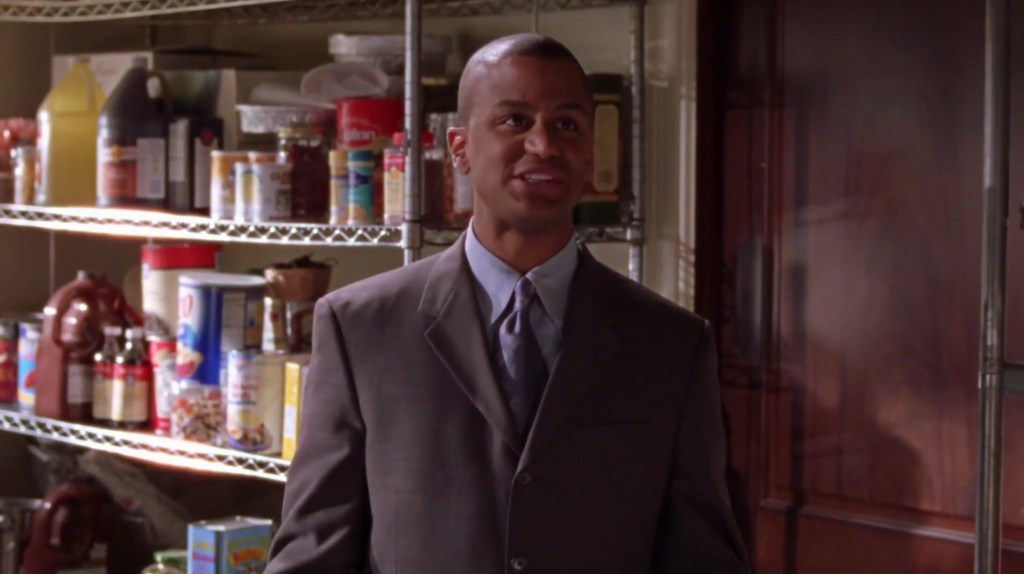
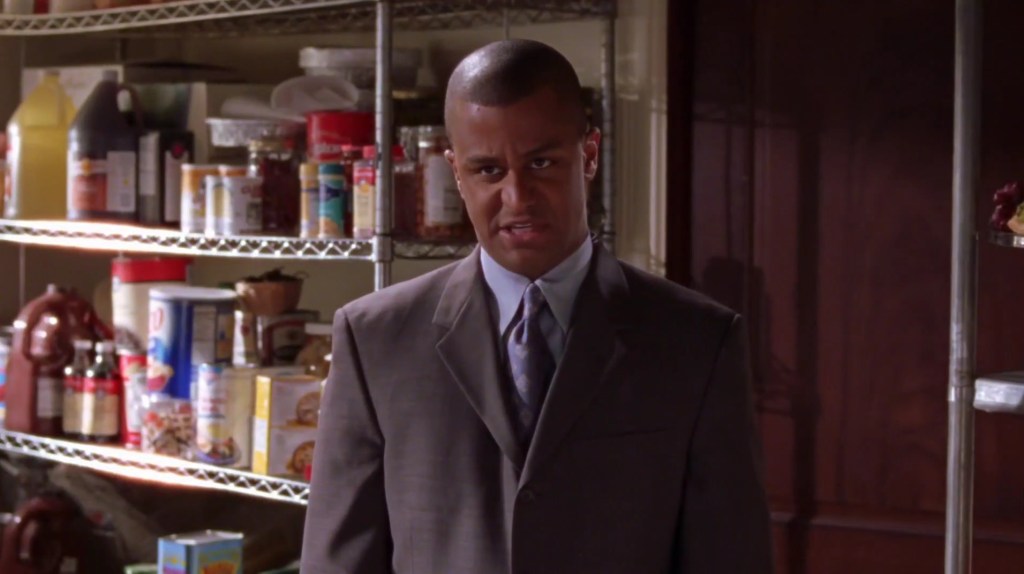
MICHEL: Now she knows I’ve been hiding something from her. Suddenly she’s asking questions. Why did I leave France at eighteen? Where do I go at night? Who are my friends? What do they do? Where do they live? Why have I chosen this career? On and on and on and on – it never ends! I can’t stand it, she’s a complete pain. She won’t stop. I took a six hour bath last night just to escape the incessant nagging. You did this to me! You turned my Giselle into a mother, and I hate you for it! I hate you very, very much! [leaves]
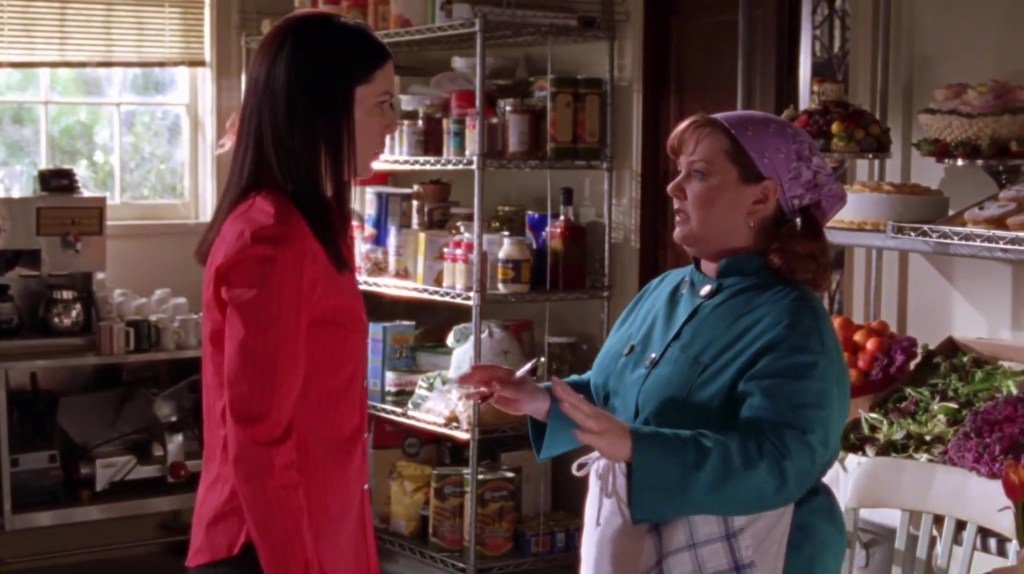
SOOKIE: So, feel better now?
LORELAI: Yeah, I do, thanks.
Lorelai is jealous of Michel and Giselle’s relationship as both a daughter, unable to spend time with Emily as Michel does with his mother, but more importantly, jealous and possessive as a parent. She has to ruin things for Michel because only Lorelai and Rory can have the “perfect” mother-and-child-yet-best-friends relationship. Sookie’s question suggests that she understands Lorelai’s feelings (although perhaps doesn’t approve of them), and has seen this coming.
MICHEL: We talk about clothes and food and Posh Spice and David Beckham and that is all.
Victoria Beckham (born Victoria Adams in 1974) was one of the Spice Girls, previously discussed, where her stage name was “Posh Spice”. After the Spice Girls split up in 2001, she began an unsuccessful solo recording career, and even before that had made her debut as a fashion model. She has gone on to become a recognised style icon.
She married English football star David Beckham (born 1975) in 1999 – he retired from sport in 2016. They have four children, and together are worth an estimated ₤355 million. At this period, their image, lives and marriage were under intense media scrutiny and a constant source of gossip. They are still married.
LORELAI: I don’t understand, Michel. You and your mother seem to have the perfect relationship.
MICHEL: Yes, because I tell her nothing. We keep all subjects light and fluffy. We talk about clothes and food and Posh Spice and David Beckham and that is all. Nothing of value, nothing of substance.
A warning to Lorelai that her “perfect relationship” with Rory likewise only works on the most superficial level. Like Michel and Giselle, their “best friends” act revolves around fashion, food, and pop culture – it’s all getting coffee, watching movies, and eating snacks together. Once anything serious comes up, they can have quite serious arguments, and even fights.
Rory actually keeps a lot from Lorelai – she hasn’t discussed her changing feelings about Dean, or her efforts to understand her feelings about Jess, for example. As Rory gets older, there will be more and more things she keeps to herself, until there is a complete rift between mother and daughter.
SOOKIE: Okay, new plan for the invites. We’re getting married May fifteenth, four o’clock, front lawn – pass it on.
There are very few exact dates given in the show, but there’s one for for Sookie and Jackson’s wedding – they’re getting married on May 15. That means that somehow the next four episodes are going to be squeezed into two and a half weeks! I don’t possess whatever time machine/portal to another dimension/magic powers that Lorelai and Rory have, so unfortunately the blog entries will not all be done for this season by May 15.
In real life, May 15 2002 was a Wednesday, but in the show, Sookie and Jackson’s wedding was on Sunday. Even when you get a firm date, it doesn’t make any sense and isn’t consistent with the timeline given.
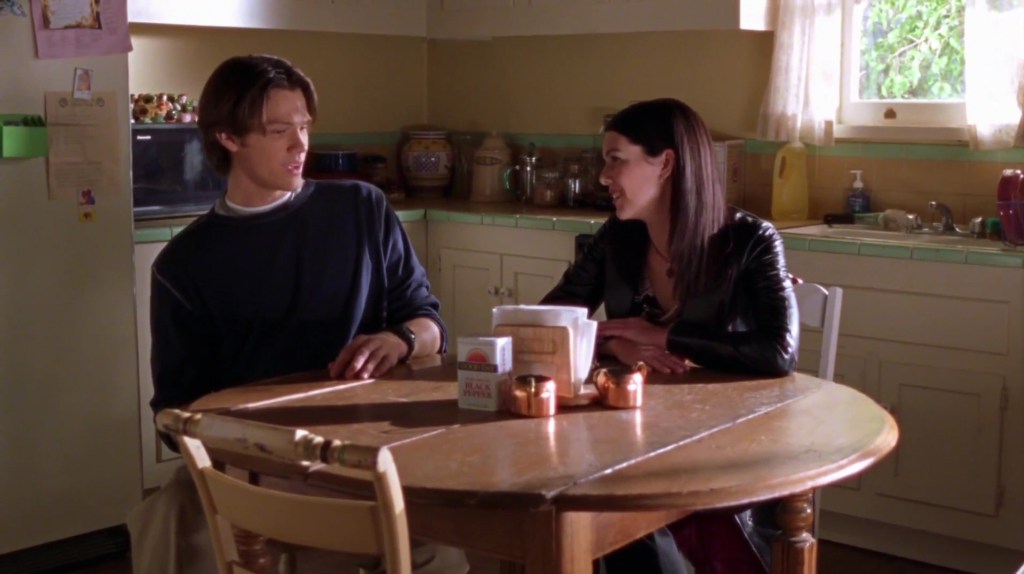
Lorelai gets home from work and finds Dean washing Rory’s car while he waits for her to come home from school (he forgot that she had to stay late again). Lorelai takes Dean into the kitchen, and suggests that he give Rory a bit more space, advice which he promises to take. This is the second relationship Lorelai meddles in, within a single afternoon, and yet another scene of Lorelai looking inappropriately flirty with Dean, rather than maternal.
MADELINE: Okay, well, first we go for the obvious – magazines.
LOUISE: You know, Teen, Young Miss, Seventeen.
MADELINE: Spin and Rolling Stone, especially to hit the guys.
RICHARD: I hear that Jane magazine also has a young, hip following.
Teen, a lifestyle magazine for teenage, published from 1954 to 2009. The magazine included articles on technology, celebrity role models, advice, quizzes, beauty and fashion, and personal essays by readers.
Young Miss, a magazine for girls which began in 1932 and ended in 2004; it was the oldest girl’s magazine in the US during its run. It began as two magazines in the 1930s called Compact (for older teens), and Calling All Girls (for younger girls). They merged into Young Miss in the 1960s, then the name changed to Young & Modern in the 1980s, before becoming Your Magazine in 2000, although known as YM in all these cases. For some reason, Louise refers to it by its 1960s title, possibly because Your Magazine might be confusing for viewers.
Seventeen, bimonthly teen magazine aimed at 13-19 year old females, published in New York City since 1944. At first providing girls with working-woman models, and information about self-development, it gained more focus on fashion and romance, but still attempts to instil self-confidence in girls. Sylvia Plath had her first short story published in Seventeen in 1950. The magazine’s cover that month featured a story on Chad Michael Murray, who had played Tristan on Gilmore Girls.
Spin, music magazine published from 1985 to 2012. It had a focus on college rock, grunge, indie rock, and hip-hop, providing an alternative to the more establishment Rolling Stone magazine. It provided extensive coverage of punk, new wave, world music, electronica, experimental jazz, and the underground scene, as well as non-mainstream cultural phenomena such as manga, monster trucks, Twin Peaks, the AIDS crisis, and outsider art. It continues to be published online.
Rolling Stone, monthly magazine focusing on music, politics, and popular culture, founded in San Francisco in 1967, but moving to New York City in 1977. From the beginning, it identified with the hippie counterculture, but distanced itself from the more radical elements and aimed for a more conventional journalism than the underground music press of the time. Hunter S. Thompson was one of its early journalists, and they covered major stories, such as the Patricia Hearst abduction, Charles Manson murders, and NASA space program.
Jane, previously discussed. This is now the third mention of the magazine. Even Richard has heard of it, slightly unbelievably! Perhaps it was research for the Business Fair project.
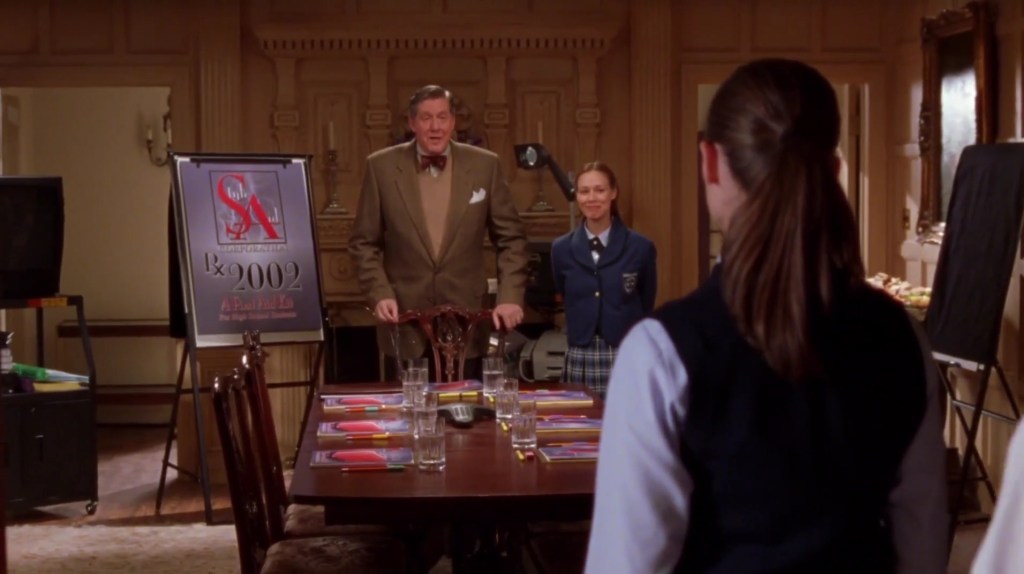
Rory is amazed that when she and the other students arrive at the Gilmore home in Hartford, Paris is already there, and greeting them as if it is her house. She and Richard clearly hit it off, and she seems to easily fit in with his plans and expectations, taking a prominent role as if she has indeed usurped Rory’s position as both group leader and granddaughter – although Richard is quick to remind everyone of Rory’s status.
This is an early hint that Paris has an affinity with older men – something which will become apparent later.
Rory says that the meeting takes place soon after 3.10 pm, but the school day doesn’t finish until 4.05 pm. This suggests that they are working during class time, even though they are meeting at Richard’s house. I’m not sure how they got permission for that, or if they even bothered to get permission. Maybe Emily fixed it up, since she is friends with Headmaster Charleston’s wife, Bitty.



 The Annotated Gilmore Girls